Glossary
Replenishment Reminder
Replenishment reminders are automated messages sent to consumers suggesting they repurchase a consumable product they've bought before. Unlike a promotional email or a generic marketing blast, a replenishment reminder is triggered by purchase history and timed to arrive when the customer is estimated to be running low. The best replenishment reminders feel like a helpful heads-up rather than a sales pitch. They land when the customer is actually thinking about the product, not on an arbitrary marketing calendar.
The distinction between a replenishment reminder and a subscription is worth emphasizing because merchants often conflate the two. Subscriptions charge the consumer automatically on a fixed schedule. A replenishment reminder simply suggests that it might be time to reorder and makes it easy to do so. There is no recurring charge, no commitment to manage, and no cancellation flow to navigate. The consumer receives the reminder, decides whether to act on it, and either purchases or doesn't. That low-friction dynamic is why replenishment reminders consistently convert at higher rates than general promotional emails. A shopper who purchased your product and is running low is far more receptive to a timely reminder than a customer receiving a blanket campaign.
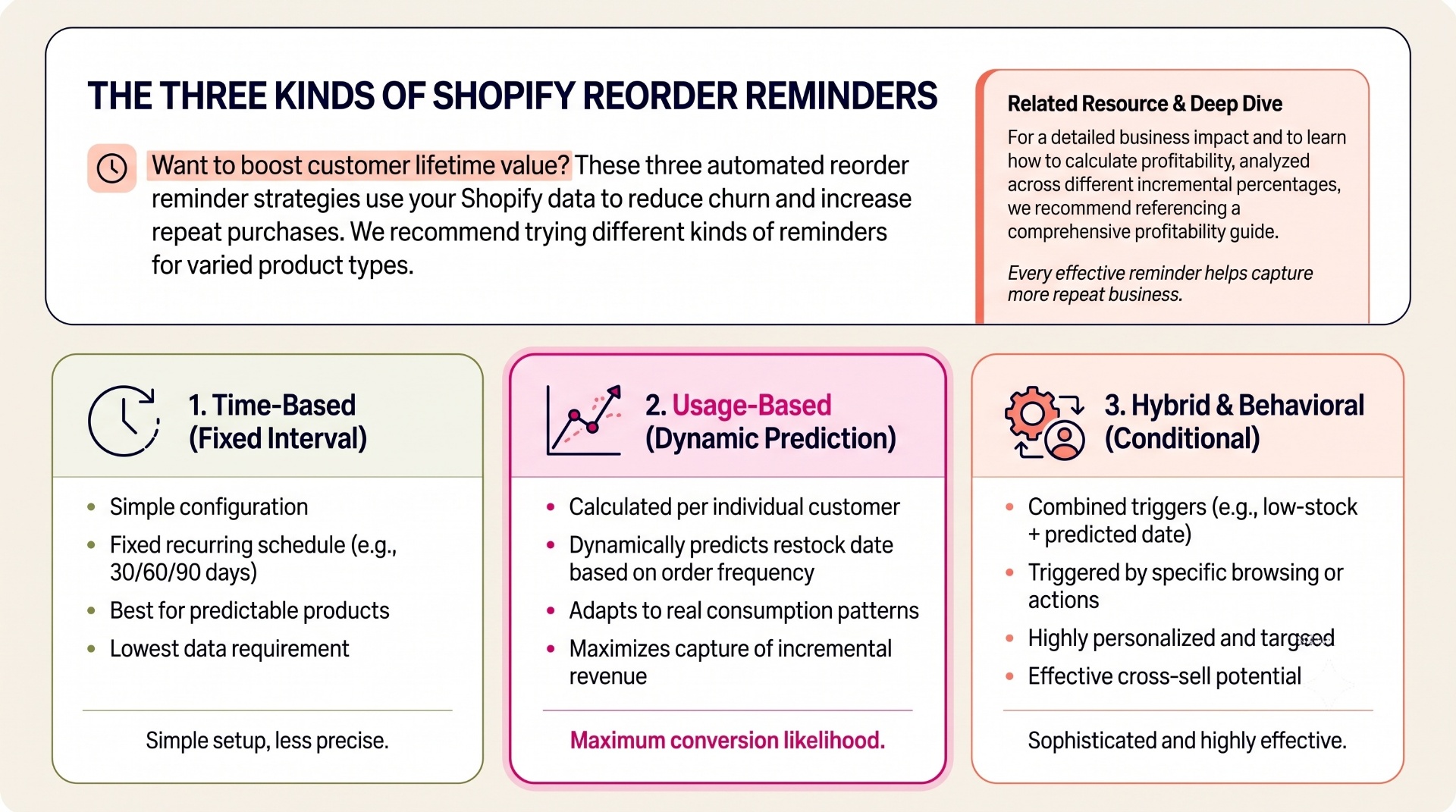
What Are The Three Kinds Of Replenishment Reminders?
Not all replenishment reminders, which are also often referred to as reorder reminders or repurchase reminders, work the same way. The approach that fits a given store depends on what the merchant knows about their products, what they know about their customers, and how much purchase history is available. There are three distinct models, each with different strengths and tradeoffs.
Usage-based replenishment reminders are configured by the merchant based on known product consumption rates. If a 30-day supply of probiotics takes roughly 30 days to use, the merchant sets a usage window and the system sends a reorder reminder as that window closes, adjusted for shipping time. This approach works from day one, including for first-time buyers with no order history, because the timing is anchored to the product rather than the customer. It's the most reliable starting point for merchants selling consumables with predictable usage cycles, including supplements, pet food, coffee, cleaning products, and personal care.
Smart/Predictive replenishment reminders use predictive modeling and AI forecasting to analyze individual customer order history to predict when the next purchase is likely. Rather than relying on a fixed product-level usage rate, AI-based timing adapts to each customer's actual buying pattern, accounting for irregular intervals, quantity variations, and seasonal shifts. This approach requires purchase history to function. For new customers or new stores with limited data, there isn't enough signal for the model to work with. But for stores with an established customer base and repeat purchase data, AI-based reorder reminder timing captures patterns that rigid usage windows would miss.
Customer-defined replenishment reminders let the buyer choose when they want to be reminded. After placing an order, the consumer selects a reorder reminder frequency for specific products. This approach requires the most upfront action from the customer, which means adoption tends to be lower. But customers who do set their own reminder have effectively pre-committed to repurchasing. They've already decided to buy again. The repurchase reminder simply closes the loop.
Which Kind of Reorder Reminder Fits Which Kind of Shopify Store?
The right choice depends on what a merchant knows and what data is available, not on which approach sounds most advanced.
| Usage-based | Smart/Predictive | Customer-defined | |
|---|---|---|---|
| Implemented by | Merchant | Predictive AI | Customer |
| Works for new customers | Yes | No (needs order history) | Yes |
| Customer action required | None | None | Yes (sets frequency) |
| Adapts to individual behavior | No (product-level timing) | Yes | Yes (customer-set) |
| Best for | Supplements, pet food, coffee, cleaning supplies, baby products | Stores with repeat data and irregular purchase patterns | Engaged buyers who know their own usage cycles |
| Limitation | Assumes uniform consumption across customers | Requires sufficient order history for accurate prediction | Requires customer awareness and upfront action |
Most online stores benefit from combining approaches. Usage-based timing provides a reliable baseline from day one. AI-based timing layers on top as order history accumulates, refining the window for individual customers. Customer-defined reminders capture intent from engaged buyers who prefer to set their own schedule. The three types aren't mutually exclusive. They're complementary.
Bold's App, rePete® Reorders, sends replenishment reminders across email, SMS, push notifications, and WhatsApp, timed to each customer's predicted reorder window. When paired with rePete®'s Smart Cart, a repurchase reminder becomes more than a message, they become a one-click reorder flow with cross-sell suggestions designed to increase the average order value of resulting reorders.