Glossary
Consumption Rate
What is consumption rate? Well. Consumption rate describes the speed with which a consumer consumes a purchased product. It's the variable that connects one recurring order to the next. Once a customer buys a consumable product, the clock starts. How fast they go through it determines when they will need more, and whether a replenishment reminder would be timely, too soon or too late.
The concept sounds straightforward, but it only sounds that way. It's surprisingly difficult to pin down. Consumption rate varies across nearly every axis a merchant might care about. Product type is the obvious one. Single-origin coffee disappears faster than a bottle of argan oil. But within the same product, consumption rate also shifts by quantity purchased, household size, usage habits, and even the season.
Take a runner buying a 30-count bottle of Maui Nui Velvet Antler (seriously, for joint relief), one capsule a day, reordering roughly every month. Then they start training up from 10Ks to their first half marathon and go to two a day. Same customer, same product, same bottle size, and the reorder window has just halved. Nothing about the product changed. The person did.
That variability is what makes consumption rate central to repeat order strategies. Systems that assume every consumer consumes at the same pace will send replenishment reminders at the wrong time to convert most of the list. Too early for the customers who consume slowly, too late for those going through the stuff quickly. Either way the message feels poorly timed and gets ignored. Effective reorder timing requires estimating consumption rate at the individual customer level, not the product level.
The Arithmetic Is the Easy Part.
Consumption rate falls out of two numbers a store already has.
Consumption rate = units purchased ÷ days until the next order of the same product
Someone buys that 30-count bottle and reorders 32 days later. Divide 30 by 32 and the rate is 0.94 units per day, so the next bottle should last about the same stretch. When the order after that lands on day 19, the rate has moved to 1.58 units per day and the predicted reorder window has to move with it. Two orders give you an interval. Three give you a direction.
But Rate Isn't Entirely Fixed.
Everything above treats consumption rate as something a store measures. That's the right starting position, and it isn't the whole story. Usage speed responds, within limits, to how well a product is explained and how easy it is to actually use. Dosage guidance. Sampling instructions. Or a pump that dispenses a sensible amount rather than a wasteful one. All of it moves the number.
And the number moves money.
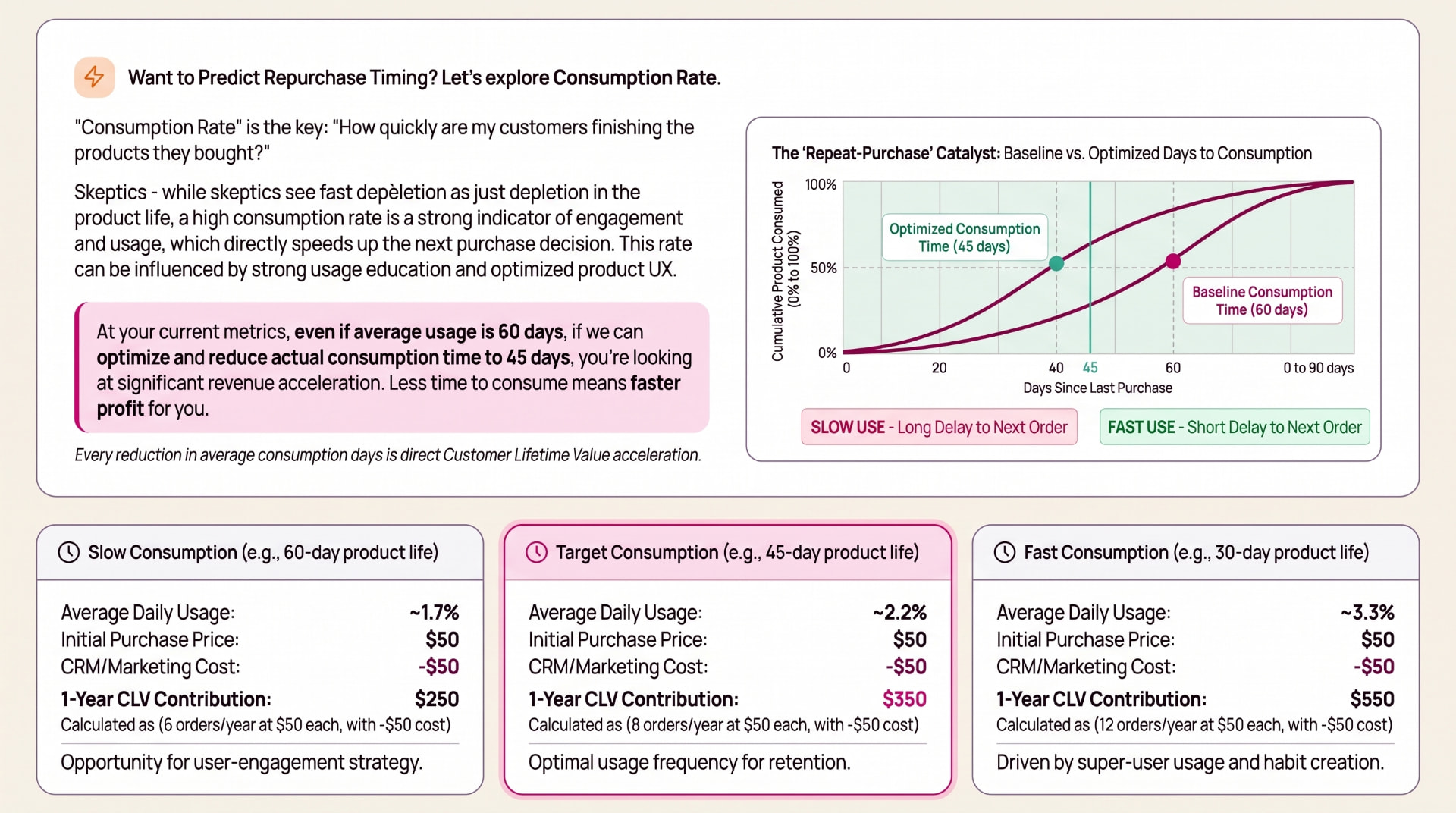
Take that $50 consumable with a flat $50 a year in marketing cost against it. At a 60-day product life the customer orders roughly six times and contributes $250. At 45 days it becomes eight orders and $350. At 30 days, twelve orders and $550. Same product, same price, same shopper, and more than double the annual contribution across the range.
Read it carefully, though. Two assumptions are doing quiet work. Marketing cost is held flat at $50 regardless of whether the customer receives six reminders or twelve, which is generous, and cost that scales with send volume narrows every gap in the model. More importantly, the arithmetic only holds when faster consumption reflects real usage. Push product out the door faster than someone can get through it and you get stockpiling, then a skipped reorder, then a customer who stops opening the emails. Usage education earns the acceleration. Pressure only borrows against it.
Consumption Rates Are Inferred, Not Measured Directly.
No ecommerce system can actually know how fast a customer is really using their beef tallow moisturizer or going through their axolotl's soft moist sinking salmon pellets. What smart tools can do is tell retailers whenever they're buying whatever. If a customer buys the same Bag Balm or the same equine mane and tail growth supplement every 45 days, a system can infer a consumption rate of 45 days. But irregular intervals suggesting variable consumption cadences require smarter solutions. Stockpiling. Promotion-based purchases. Seasonal variations, like sunscreen sales spiking in summer but lip balm in the winter. All of it introduces noise into the analysis.
| Signal | What it suggests | Where it misleads |
|---|---|---|
| Days between orders of the same item | Baseline consumption rate | Stockpiling during a promotion stretches the gap without changing usage |
| Units per order | Scale of household demand | Bulk buying compresses the order count while usage stays flat |
| Order timing across a year | Seasonal swing in usage | Sunscreen in July and lip balm in January are calendar effects rather than rate changes |
| Gaps that keep widening | Usage slowing down | Equally consistent with the customer buying the same product somewhere else |
Every one of those signals is real and none of them is clean. Estimating well means weighing them against each other rather than trusting whichever gap happened most recently.
For Shopify merchants and other online retailers evaluating reorder reminder strategies, consumption rate is the foundational concept that everything else depends on. Predicted reorder windows are built on it. Repeat order timing adapts to it. The accuracy of every replenishment reminder nudge traces back to how well the system estimates how fast each customer goes through each consumable product.